

I am currently thinking of renaming this blog something like “Lazarus Taxon” or “Living Fossils” because I seem to keep going extinct only to reappear randomly after a long stratigraphic hiatus…
But, yes, I am here. I am still alive and still somewhat active in paleontology. The last post I made here was well over a year ago and a lot has changed since then. For starters, I have been very busy with work. I returned to teaching full time in Fall 2024 and have been neck-need in class prepping, grading, and other projects since. I’ve barely had time to blog about baseball and that’s the other half of his site (and the Cubs drove me nuts all year).
But I return today because news broke of a pretty significant development in the world of dinosaur paleontology; one that many of us (myself included) never thought would really happen:
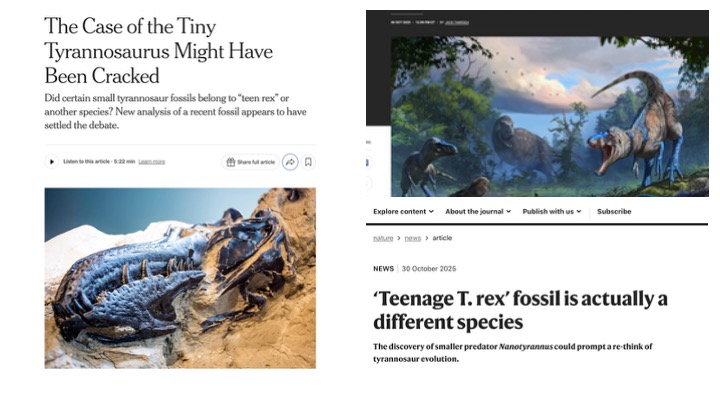
Yes, Virginia, it looks like after all this time, there is a Nanotyrannus. And it was the specimen of the “Dueling Dinosaurs” from the North Carolina Museum of Natural Sciences that clinched it.
Nanotyrannus is real after all!
Folks who know me, follow me on social media, or just are aware I exist, know I had very strong opinions on the validity of Nanotyrannus. So strong in fact that I wrote two very long blog posts explaining why it was not a thing! The first was in in 2020 when the Woodward et al. paper came out and the second was in 2024 when the Longrich & Saittia paper came out. The 2020 post was more of a story where I wanted to celebrate how paleontologists build a consensus on a topic over time (and celebrate what I thought was the nail in the coffin); the one in 2024 was a critique of a paper that tried to re-hash old evidence that had been debunked (more on this later).
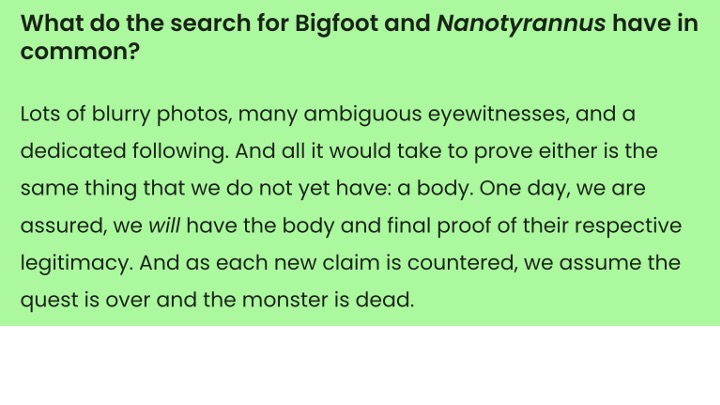
I stand by what I wrote in both and I will not apologize for my stances in either summary. In both cases, the data in 2020 and 2024 pointed to the conclusion that Nanotyrannus was just a juvenile T.rex (or “teen rex”). And in the case of the 2024 paper, the evidence presented was nothing new that hadn’t already been debunked. In fact, in that post, I compared it to the quest for Bigfoot:
But, I was wrong.
Today, because I had so vociferously defended the position “Nanotyrannus is not real”, I felt it important to write this post. I don’t want any ambiguity on how I felt then and feel now on the subject. Therefore, I am formally adding my name to the list of folks who were firmly in the “Nanotyrannus isn’t real” camp and were wrong. I felt given the nature of many of my comments and interactions on the subject, I needed to make this as clear as I could. So I will say again:
I was wrong. Nanotyrannus is a valid taxon.
I first got wind something was up when Tom Holtz and Darren Naish were being vague on social media about something coming out. Then today, while my students were taking a test, I saw the news.
Quite honestly, this is cause for celebration. For years, I was “anti-NanoT” because we literally only had basically blurry photos and lots of eyewitness testimony but no real body to speak of.
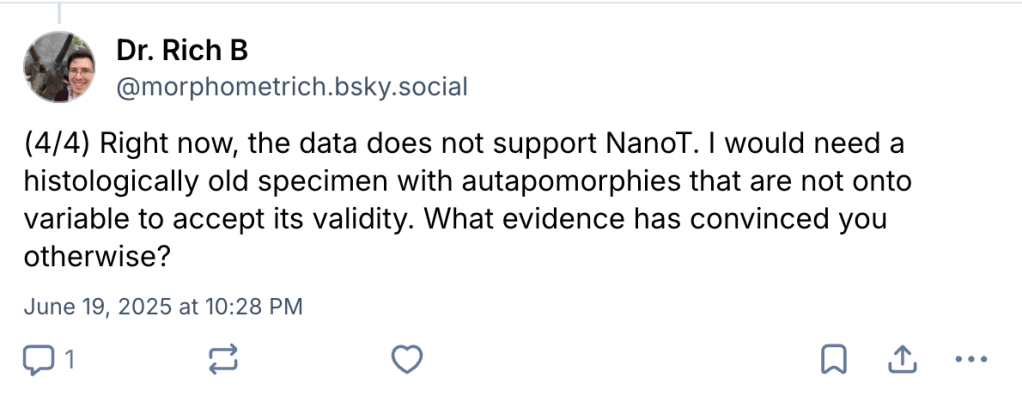
But Christmas came early. Authors Lindsay Zanno and James Napoli delivered the literal “Holy Grail” to paleontologists: a histologically old specimen with autapomorphies. I celebrated the Woodward et al. (2020) paper because bone histology is that one thing that is not up for debate. In the Woodward et al. (2020), they showed the specimen known as “Jane” at the Burpee Museum in Rockford Illinois was an immature individual. Now, this new specimen [spoiler alert] was estimated to be 20 years old at the time of its death (so histologically mature) and about half the size of a T.rex.
There’s no debate there. The “Dueling Dinos” tyrannosaur is not a “teen rex”. Whatever it is, it is an adult.
While the devotion to the existence of NanoT did frequently border on religious fanaticism for some, there are those who kept doing good, serious work on the subject and their continued testing is just a testament for how science works in the long run. Science is a process of systematic inquiry whose findings should be value neutral and free from bias. If you are adhering to the process and doing good work within your field using established methods, you can trust your data. And when data changes, you change your conclusions.
And that is exactly what I am doing now. I got new data on the subject and I am changing my conclusions.
A Word of Caution
To those who likely felt maligned in paleontology for their “belief” in the validity of Nanotyrannus, you are entitled to a victory lap here.
However, this is not any sort of “gotcha” moment. Those of us having to “admit we were wrong” is all part of the process of doing science. The work that attempted to support the validity of Nanotyrannus until this point was, in general, bad science. The arguments put forth in a plethora of papers I referenced in the two blog posts brought nothing new to the table (and in the case of the 2024 paper, left major holes that I discussed). And the fact that these arguments were tried again, and again, and again only to be debunked each time was frustrating.
The Cubs winning the World Series in 2016 does not absolve Manager Joe Maddon of blame for his utter mismanagement of the bullpen in Games 6 and 7… nor does Zanno and Napoli finally giving us the evidence we need justify the validity Nanotyrannus excuse decades of shoddy work. Celebrate the accomplishment but recognize that the previous work is not validated by this. If anything, the work done by Zanno & Napoli show what good science can accomplish and how lackluster the other work was by comparison.
And, if anything, this brings a new tyrannosaur into the family!!
What’s Next?
This is where the fun begins!

I am writing this in the evening on October 30 eagerly awaiting the journal Nature to release the dang paper. For some reason, the news leaked before the article was finalized. So all I have been able to read has been the commentary and news (links below). I am literally on pins and needles waiting for it even though I have a mountain of grading and prep to do this weekend.
But what does this mean?
- I need to get off my butt and get back to my tyrannosaur morphology-ecology paper from my dissertation. The fact that we have another tyrannosaur in the Hell Creek just adds to the implications of niche partitioning and competition that were written about by Holtz (2021) and Schroeder et al. (2021). And my skull dataset probably needs to be re-labeled.
- Zanno & Napoli seemed to think that Burpee’s “Jane” is actually a species of Nanotyrannus: N. lethaeus. This I don’t know if I am ready to buy yet (again, need to read the paper if/when Nature releases it). I am very cautious about this latter assignment. Woodward et al. (2020) placed Jane as a juvenile based on its histology. But the question now is: a juvenile what? As Thomas Carr pointed out: if all the “teen rexes” are NanoT’s… where are the immature T.rexes?
- Really pin down the morphology of Nanotyrannus in general. What I am hoping to read (or see in the future) is full confirmation that traits X, Y, and Z are specific to NanoT and not shared with T.rex. This will help separate what is a NanoT from what is a T.rex. And personally, I think this is going to be difficult. I actually think there is a combination of ontogeny recapitulating phylogeny AND niche competition that are going to mess with this and lead to more fighting. If “teen rexes” were occupying the same niches based on size and morphology as NanoT, then their morphology is likely to be very, very, similar…
But that’s for another day.
Some Light Reading
Nature Commentary: ‘Teenage T. rex’ fossil is actually a different species by Katie Kavanagh
New York Times: The Case of the Tiny Tyrannosaurus Might Have Been Cracked by Asher Elbein
Science Commentary: Mini-tyrannosaur lived alongside T. rex, extraordinary fossil confirms by Jack Tamisiea
Nature commentary by paleontologist Lawrence M. Witmer: T. rex debate settled: contested fossils are smaller rival species, not juveniles
 A Dinosaur in the Dugout